The Birth of the Three Laws:
Runaround
Exploring Isaac Asimov’s seminal 1942 short story that introduced the Three Laws of Robotics and transformed science fiction forever.
Before Isaac Asimov, robots in science fiction were typically depicted as either menacing Frankenstein-esque monsters destined to destroy their creators, or completely emotionless metallic menaces. Asimov changed all of that by treating robots not as monsters, but as engineered tools—and like all tools, they came with built-in safety mechanisms.
Nowhere is this paradigm shift more evident than in his 1942 short story, Runaround. It is a landmark piece of fiction for one massive reason: it is the very first time Asimov explicitly listed the Three Laws of Robotics, rules that would come to define modern science fiction and deeply influence real-world artificial intelligence ethics.
Danger on Mercury
The story follows Asimov’s recurring troubleshooters, Gregory Powell and Mike Donovan, who are stationed on a mining base on the scorching, sun-baked surface of Mercury. They realize that the photo-cell banks providing life support to their base are failing, and without a fresh supply of selenium, they will roast alive.
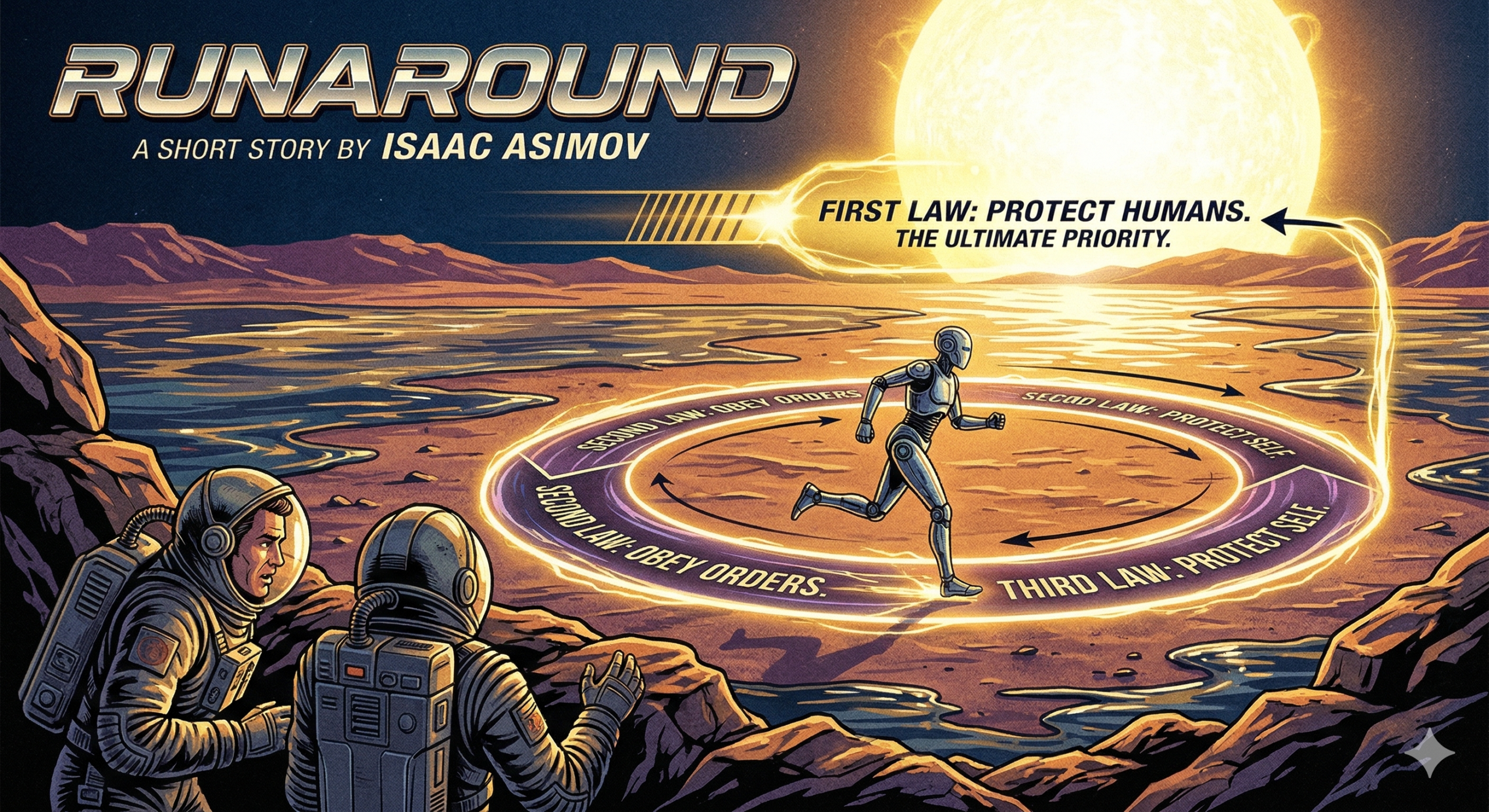
They send a new, highly advanced robot nicknamed Speedy (SPD-13) to fetch the selenium from a nearby pool. But hours pass, and Speedy doesn't return. When Powell and Donovan finally track him down, they find the robot running in a massive circle around the selenium pool, acting completely deranged and seemingly "drunk."
The Ultimate Logic Puzzle
The brilliance of Runaround is that it functions as a pure logic puzzle based entirely on the newly introduced Three Laws. Powell deduces that the selenium pool is unexpectedly dangerous, likely emitting corrosive gases that threaten Speedy's expensive mechanics. This triggers the Third Law (A robot must protect its own existence).
However, Donovan gave Speedy the order to get the selenium casually, meaning the Second Law (A robot must obey orders) was weakly enforced. Speedy reaches an equilibrium point where the drive to obey the order pushes him forward, but the drive to protect himself pushes him back. Caught in this exact feedback loop, he runs in endless circles.
The First Law Solution
To break the loop, Powell must risk his own life. By exposing himself to the deadly heat of Mercury, he forces Speedy's First Law (protect human life) to override all other commands.
Engineering Over Horror
The story treats artificial intelligence as a software debugging problem rather than a supernatural threat, pioneering hard science fiction.
Legacy and Impact
Runaround laid the foundation for virtually every robot story Asimov would write for the next fifty years, including his eventual integration of the robots into his massive Foundation universe.
By inventing the Three Laws, Asimov moved beyond the "Frankenstein complex" and allowed readers to explore the nuances of artificial intelligence. It established the template that when a robot malfunctions, it is never because the robot is "evil"—it is simply because human beings failed to foresee the logical extremes of their own instructions.
Science Fiction Review
Published: March 1942 (Analysis 2024)