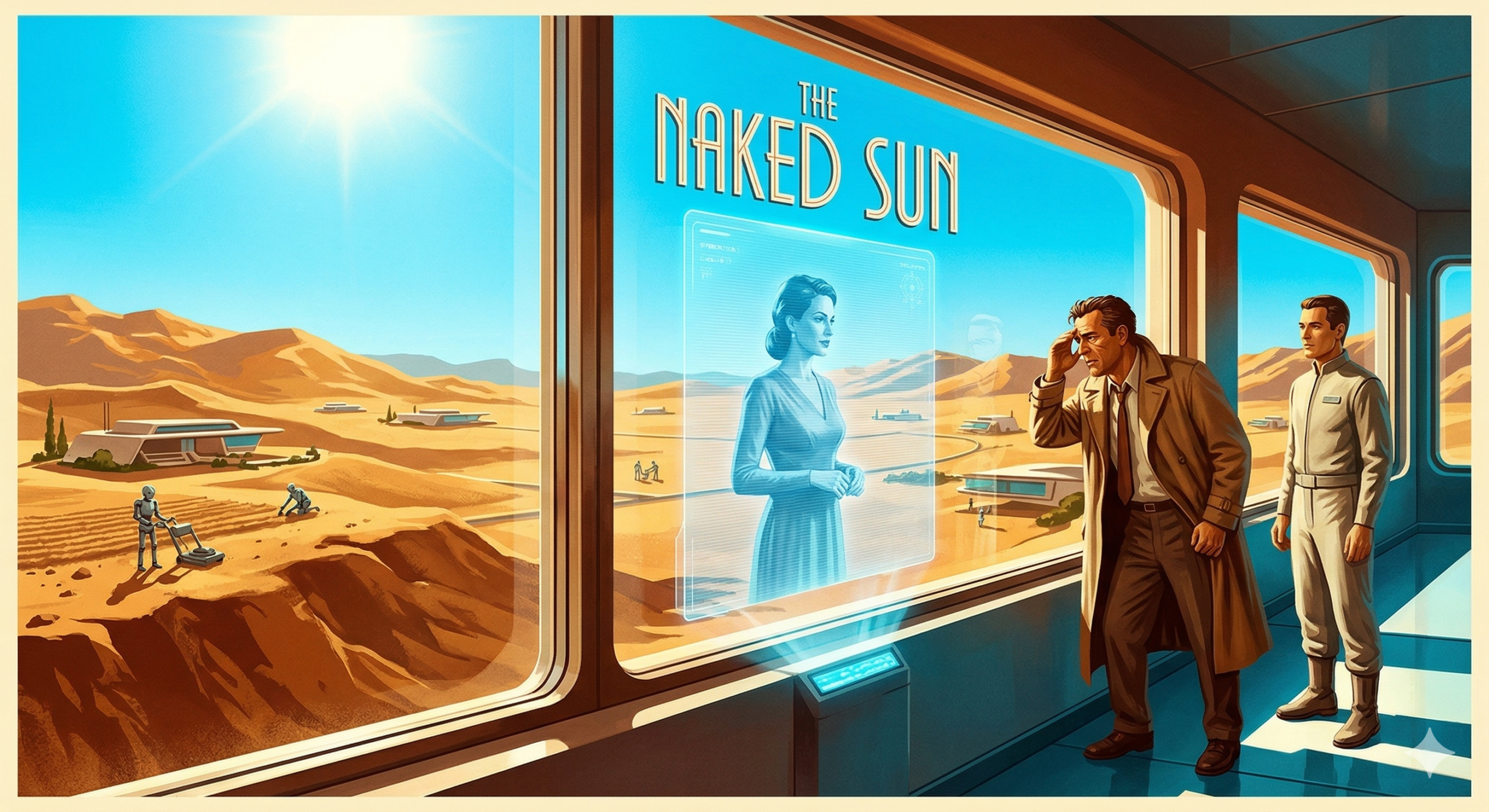
Solaria's Secrets:
The Naked Sun
Exploring Isaac Asimov’s 1957 sequel and its chilling vision of absolute isolation and extreme individualism.
Following the groundbreaking success of The Caves of Steel, Isaac Asimov inverted his own formula. If his first robot mystery explored the psychological crush of extreme overpopulation, his 1957 sequel, The Naked Sun, serves as its perfect philosophical mirror, examining a society pushed to the absolute limits of underpopulation and isolation.
Once again blending the rigor of a classic whodunit with profound sociological speculation, Asimov strips his Earth-bound detective of everything familiar, forcing him to face his deepest fears under the blinding light of an alien sun.
The World of Solaria
The mystery takes Detective Elijah Baley off Earth for the first time, to the Spacer world of Solaria. Solaria is a planet of unimaginable wealth, populated by only twenty thousand humans and tens of millions of robots. Each Solarian lives on a vast, continent-sized estate, absolutely isolated from their fellow humans.
This extreme social distancing has created a society where human contact is literally nauseating. It is an environment completely alien to Baley, who has spent his entire life in the shoulder-to-shoulder, agoraphobic confines of Earth's subterranean cities.
An Impossible Crime
Baley is summoned to Solaria to solve the murder of Rikaine Delmarre, a prominent "fetologist." The case is an impossible paradox. To kill Delmarre, someone had to be physically present. However, Solarians physically cannot bear to be near one another, and robots are strictly bound by the First Law of Robotics, preventing them from causing harm.
The prime suspect is Delmarre's wife, Gladia, who was found unconscious at the scene. To navigate this bizarre culture, Baley is once again partnered with the humaniform robot R. Daneel Olivaw. Together, they must untangle a web of Solarian neuroses, robotic loopholes, and planetary conspiracies.
The Agoraphobia Test
Baley's personal journey forces him to confront his crippling fear of open spaces and the literal "naked sun."
The Danger of Isolation
Solaria represents a technological dead-end: a society so reliant on machines it has lost its humanity and drive.
Legacy and Impact
The Naked Sun masterfully expands Asimov's universe, deepening the bond between Baley and Daneel while introducing Gladia, a character who will play a pivotal role in the future history of the galaxy.
By contrasting Earth's claustrophobic stagnation with Solaria's agoraphobic isolation, Asimov presents a compelling argument for human expansion. The novel proves that humanity's future lies not in hiding from the universe, but in boldly stepping out under the naked sun.
Science Fiction Review
Published: 1957 (Analysis 2024)