Krebs Cycle, Citric Acid Cycle, or Tricarboxylic Acid Cycle (TCA)
The TCA cycle, is a series of chemical reactions that are used by all aerobic organisms to generate energy. The cycle takes in acetyl-CoA, a molecule that is produced from the breakdown of glucose, and produces carbon dioxide, NADH, FADH2, and ATP.
Krebs cycle
The compounds that are involved in the Krebs cycle are often named as acids or "ates". This is because they contain carboxyl groups, which are functional groups that consist of a carbon atom bonded to two oxygen atoms. The carboxyl group can lose a hydrogen atom to form a negatively charged carboxylate ion, which is what gives acids their sour taste.
In the Krebs cycle, some of the compounds are shown as acids, while others are shown as "ates". This is because the oxidation state of the carbon atom in the carboxyl group can vary. In some compounds, the carbon atom has a higher oxidation state and is therefore shown as an acid. In other compounds, the carbon atom has a lower oxidation state and is therefore shown as an "ate".
For example, the compound oxaloacetate is shown as an "ate" because the carbon atom in the carboxyl group has a lower oxidation state of +3. The compound citrate is shown as an acid because the carbon atom in the carboxyl group has a higher oxidation state of +5.
The use of acids and "ates" to name the compounds in the Krebs cycle can be confusing, but it is important to remember that the oxidation state of the carbon atom in the carboxyl group determines whether the compound is shown as an acid or an "ate".
Here is a table of some of the compounds in the Krebs cycle and their oxidation states:
| Compound | Oxidation State of Carbon Atom in Carboxyl Group |
|---|---|
| Oxaloacetate | +3 |
| Citrate | +5 |
| Isocitrate | +4 |
| α-Ketoglutarate | +3 |
| Succinyl-CoA | +4 |
| Succinate | +3 |
| Fumarate | +2 |
| Malate | +3 |
| Oxaloacetate | +3 |
As you can see, the oxidation state of the carbon atom in the carboxyl group increases as the compound progresses through the Krebs cycle. This is because the carbon atom is oxidized, which means that it loses electrons. The loss of electrons releases energy, which is used to produce ATP.
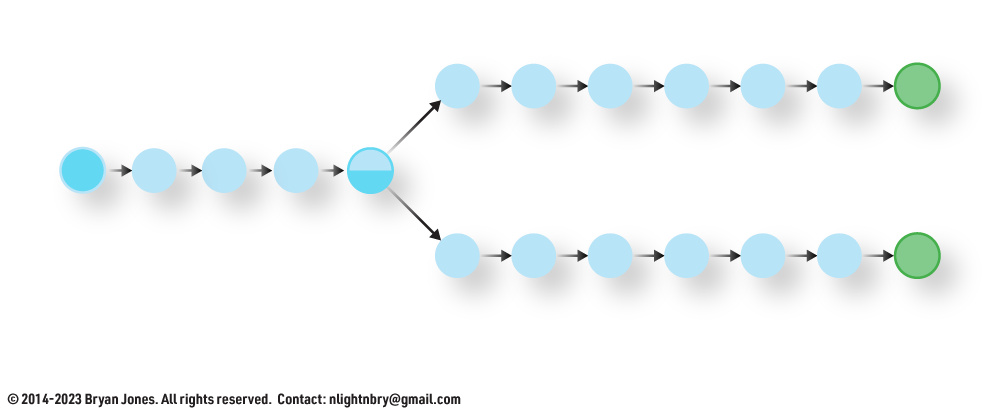
Glycolysis Pathway
Glycolysis is a process by which glucose is broken down into two molecules of pyruvate, generating energy in the form of ATP and NADH. In most organsims it occurs in the cytosol. Final product is used as the first step in Kreb's Cycle.
Kreb's Cycle
GRAPHIC 
Kreb's Cycle "ate"
GRAPHIC 
Kreb's Cycle - Enzymes
GRAPHIC 
Krebs Cycle - Acids
GRAPHIC 
Fermentation of Alcohol (Ethanol)

Fermentation of Alcohol (Ethanol)

Krebs Cycle - Enzymes

Graphic representation of Glycolysis
Graphic representation of Glycolysis 
Energy Produced | Free energy changes
This table shows the ΔG°′ (free energy change under standard conditions) and ΔG (free energy change under cellular conditions) for each step of glycolysis.
The standard conditions are a set of conditions that are not realistic for the cell, but they are used to make it easier to compare the free energy changes of different reactions. The cellular conditions are the conditions that exist inside the cell, and they are more realistic than the standard conditions.
Energy Produced | Table | 1
| Step | Reaction | ΔG°′ (kJ/mol) | ΔG (kJ/mol) |
|---|---|---|---|
| 1 | Glucose + ATP → glucose-6-phosphate + ADP | -13.8 | -10.3 |
| 2 | glucose-6-phosphate → fructose-6-phosphate | 0.0 | -2.1 |
| 3 | fructose-6-phosphate + ATP → fructose-1,6-bisphosphate + ADP | -16.3 | -14.8 |
| 4 | fructose-1,6-bisphosphate → dihydroxyacetone phosphate + glyceraldehyde-3-phosphate | -1.7 | -0.3 |
| 5 | dihydroxyacetone phosphate → glyceraldehyde-3-phosphate | 0.0 | -0.4 |
| 6 | glyceraldehyde-3-phosphate + NAD+ → 1,3-bisphosphoglycerate + NADH | -19.9 | -12.7 |
| 7 | 1,3-bisphosphoglycerate + ADP → 3-phosphoglycerate + ATP | -10.4 | -5.9 |
| 8 | 3-phosphoglycerate → 2-phosphoglycerate | -0.9 | -2.6 |
| 9 | 2-phosphoglycerate → phosphoenolpyruvate | -1.3 | 0.3 |
| 10 | phosphoenolpyruvate + ADP → pyruvate + ATP | -14.2 | -7.5 |
Energy Produced | Table | 2
| Step | Reaction | ΔG°′ (kJ/mol) | ΔG (kJ/mol) |
|---|---|---|---|
| 1 | Glucose → Glucose-6-phosphate | -16.7 | -20.9 |
| 2 | Glucose-6-phosphate → Fructose-6-phosphate | 1.7 | -3.4 |
| 3 | Fructose-6-phosphate → Fructose-1,6-bisphosphate | -14.2 | -16.3 |
| 4 | Fructose-1,6-bisphosphate → Dihydroxyacetone phosphate + Glyceraldehyde-3-phosphate | 23.8 | 1.7 |
| 5 | Dihydroxyacetone phosphate → Glyceraldehyde-3-phosphate | 7.5 | 0.2 |
| 6 | Glyceraldehyde-3-phosphate → 1,3-Bisphosphoglycerate | -18.5 | -49.4 |
| 7 | 1,3-Bisphosphoglycerate → 3-Phosphoglycerate | -49.4 | -18.8 |
| 8 | 3-Phosphoglycerate → 2-Phosphoglycerate | 1.7 | 3.4 |
| 9 | 2-Phosphoglycerate → Phosphoenolpyruvate | 7.5 | 1.7 |
| 10 | Phosphoenolpyruvate → Pyruvate | 31.4 | 14.8 |
Ratio of NAD+ to NADH
The ratio of NAD+ to NADH is also important for other cellular processes, such as DNA repair and cell signaling.
1000:1
The ratio of NAD+ to NADH in the cytoplasm is typically around 1000:1. This means that there are 1000 molecules of NAD+ for every molecule of NADH. This high ratio is important for the oxidation of glyceraldehyde-3-phosphate (step 6 of glycolysis), which is a reaction that requires NAD+.
Redox Reaction
The oxidation of glyceraldehyde-3-phosphate is a redox reaction, which means that it involves the transfer of electrons. In this reaction, glyceraldehyde-3-phosphate is oxidized and NAD+ is reduced to NADH. The high ratio of NAD+ to NADH means that there are plenty of NAD+ molecules available to accept the electrons from glyceraldehyde-3-phosphate, which makes the reaction more likely to occur.
The ratio of NAD+ to NADH decreases as more NADH is produced.
The ratio of NAD+ to NADH can change depending on the metabolic state of the cell. For example, during exercise, the ratio of NAD+ to NADH decreases as more NADH is produced. This is because NADH is needed to generate ATP, which is the cell's main source of energy.
TCA / Krebs Cycle
Oxidative metabolism of Acetyl-CoA within the mitochondrial matrix.
Acetyl-CoA
Entry: 2-CarbonTCA Cycle Dynamics
Intermediate
6CEnzyme Name
Alternate Nomenclature & Synonyms
Contents